There is a rush to build markets for nature. Biodiversity credits. Nature bonds. Outcome-linked instruments. The pitch is seductive: price a hectare, sell the upside, let private capital do the rest.
Lemu began with that same assumption five years ago. We knew measurement had gaps — we launched a satellite, Lemu Nge, to help close them. What we underestimated was the kind of gap. Not just sharper images or wider coverage, but provenance: every number traceable from raw signal to asserted fact. A market runs on numbers people can defend, and building that took far longer than building the satellite. The foundation comes before the market — and it is still being poured.
A new review in Nature Reviews Biodiversity — Demystifying biodiversity finance, by Carter and colleagues at Oxford — is the most honest map of this terrain I have read. It deserves attention from anyone selling, buying, or building nature finance.
Two phrases worth separating
The field splits into two ideas the review names plainly:
- Greening finance — aligning the existing financial system with nature. Disclose exposure. Price risk. Redirect capital away from harm.
- Financing green — raising new capital for positive outcomes. Credits, bonds, equity, the marketplace.
Almost all the excitement is about financing green. Almost all the near-term leverage is in greening finance. That gap is where the work starts.
The numbers say where the leverage is
The review brackets greening finance to study the return-seeking side in detail. But its own figures make the case for the opposite priority:
- US$7.3 trillion a year in financial flows runs against nature.
- Voluntary biodiversity credits have attracted roughly US$8 million to date.
- REDD+ credit transactions fell 63% in 2024 after the over-crediting scandal — while money shifted to removal-based credits buyers found easier to verify.
- There is still no fungible unit of nature — no CO₂-equivalent for biodiversity that trades at scale.
Read those together. The marketplace for new green capital is still small and contested. The pool of harmful capital is colossal. Bending the US$7 trillion is the bigger short-term win — by orders of magnitude.
Why measurement is the bottleneck, not appetite
The review's sharpest contribution is its taxonomy of why these mechanisms struggle. Two risks recur:
- Impact risk — the project does not deliver the outcome.
- Measurement risk — the outcome is delivered, but assessed badly. Weak counterfactuals. Metrics the authors call premature, simple, vague, or coarse.
This is the part the market keeps skipping. Every credit, every bond, every equity story is only as credible as its measurement. When measurement fails, value evaporates — as REDD+ showed the whole market.
So the binding constraint is not investor appetite. It is trustworthy measurement. Build that, and the financing-green mechanisms become bankable. Skip it, and you are issuing instruments on numbers no one can defend.
What this means for business — and for Lemu
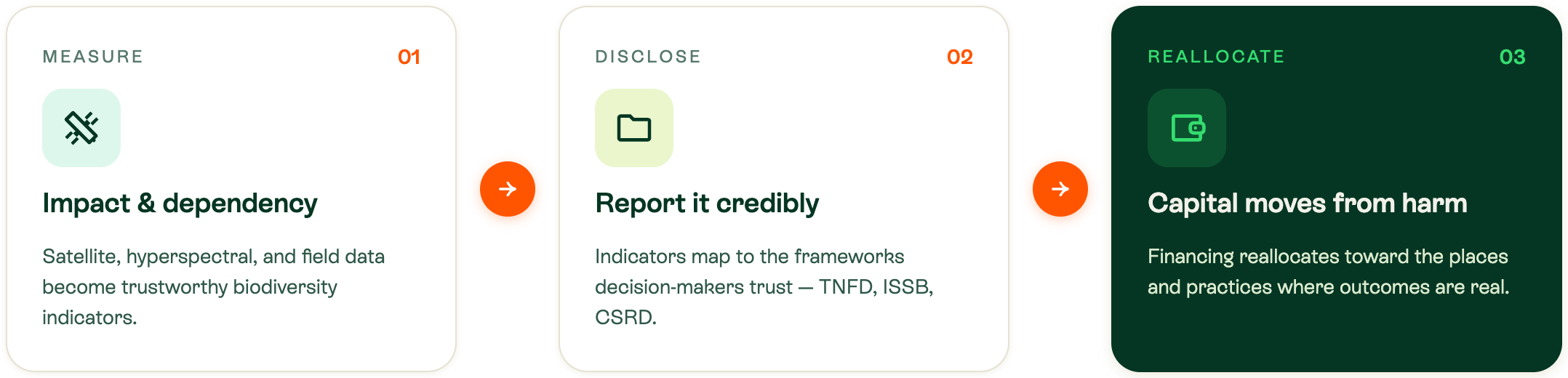
The fastest capital reaching nature does not have to wait for a new credit. It begins the moment a company can see its own impact and dependence on nature, and report it credibly against TNFD, ISSB, and CSRD.
That is greening finance in practice. And the chain is direct:
Measure impact and dependency → disclose → capital reallocates away from harm.
There is a second, quieter channel. When a company pays to monitor its territory, that spend is capital reaching a real place, before any marketplace exists. It puts the measurer in the chain of custody of that land. Capital reaches nature on day one, not at some future exit event.
Credits are not the rival here. They are the destination. No company reduces its footprint to zero, and the residual it cannot eliminate is exactly what a credit is for. Measure first, and every credit bought afterward is worth more, because it is bought by someone who already did the accounting.
This is the work Lemu does today. Atlas measures. Spacetime makes every measurement traceable and auditable. The result is a number a CFO can stand behind and a regulator can check.
We are not walking away from markets
We are walking toward them in the right sequence. The marketplace for campaigns, credits and expertise is on our roadmap, and the monetary lens that prices a hectare is being built now. Biodiversity finance will grow. The review is right that public investment and philanthropy stay essential, and right that scaling the rest is not yet proven.
But the precondition for all of it is the same: measurement you can trust.
So our priority is not to rush an emerging market. It is to lay the foundation that makes every future market credible — and, in the meantime, to help business green the finance it already moves.
The opportunity is exactly as large as the gap. Our job is to make the cost of measuring nature lower than the cost of ignoring it.
Reference: Carter, H., Thompson, B. S., Bull, J. W., Dickman, A., Jones, J. P. G., Shrikanth, S. & zu Ermgassen, S. O. S. E. (2026). Demystifying biodiversity finance. Nature Reviews Biodiversity 2, 388–401. https://www.nature.com/articles/s44358-026-00155-z
Disclosure: Lemu is a member of the Biodiversity Credit Alliance. We build the measurement layer these markets depend on, which is precisely why we argue the foundation must come before the marketplace.